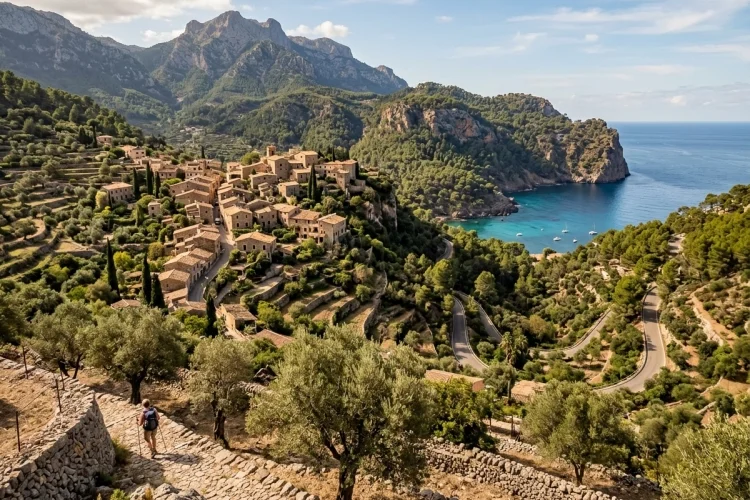
Mallorca is famous for sunny resorts, lively promenades, and long days beside the pool. However, travel beyond the busiest coastal areas and the island begins to feel completely different.
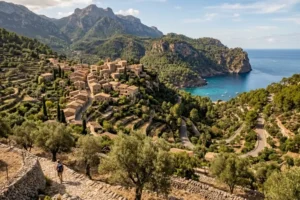
Stone villages cling to mountain slopes, olive terraces follow ancient walls, and narrow roads twist towards tiny coves hidden below pine-covered cliffs. Exploring Mallorca beyond the resorts means slowing down and looking past the familiar package-holiday experience.
You might spend the morning walking through a medieval village, eat lunch beside an orange grove, hike part of an old dry-stone trail, and finish the day swimming in a rocky Mediterranean inlet.
The island’s contrasts make it perfect for independent travellers, couples, hikers, photographers, and anyone who wants more than a standard beach break.
You do not need to avoid the coast entirely. The goal is simply to combine Mallorca’s clear water with its mountain culture, rural landscapes, local food, and quieter communities.
1. Discover the Serra de Tramuntana
Running parallel to Mallorca’s northwestern coast, the Serra de Tramuntana is the island’s dramatic mountain backbone. Its landscape includes steep peaks, forests, agricultural terraces, water channels, dry-stone structures, villages, and small fishing ports.
UNESCO added the area to its World Heritage List in 2011 as a cultural landscape shaped by centuries of interaction between people and a challenging mountain environment.
The region is ideal for scenic driving, but the roads are narrow and winding. Short distances may take longer than expected, especially when buses, cyclists, and limited village parking are added to the journey.
Instead of attempting to cover the entire mountain range in one day, choose a smaller section. A route connecting Valldemossa, Deià, Sóller, and Fornalutx offers a balanced introduction to the region’s villages, viewpoints, food, and landscapes.
2. Wander through Mallorca’s Stone Villages
Valldemossa
Valldemossa is one of the most popular mountain villages, but it still rewards visitors who arrive early or stay until the day-trippers leave. Its steep lanes, stone façades, flowerpots, small bakeries, and surrounding hills create an easy introduction to rural Mallorca.
The village lies within the Serra de Tramuntana cultural landscape and has long been associated with artists and travellers. Its small coastal port, Port de Valldemossa, is around six kilometres away and offers a more rugged atmosphere than the island’s developed beach resorts.
Try a coca de patata, a soft local potato bun often served with coffee or hot chocolate. Then leave the busiest streets and walk towards the village’s quieter residential edges.
Deià
Deià sits between mountains and the sea, with stone houses arranged around the slopes of Teix mountain. The village has a creative reputation, stylish restaurants, walking paths, and impressive coastal viewpoints.
Stop at the Son Marroig viewpoint for views towards Sa Foradada, a rocky peninsula named after its large natural opening. The viewpoint is particularly striking in the evening, although sunset periods can become busy.
Fornalutx and Sóller
Fornalutx is smaller and quieter, with narrow lanes, decorated roof tiles, fountains, stone steps, and mountain scenery. Its carefully preserved architecture has earned it recognition as one of Spain’s most beautiful villages, while its location provides easy access to walking and cycling routes.
Nearby Sóller feels livelier. Its valley is associated with citrus groves, while the old town has a central square, historic buildings, shops, and transport connections to Port de Sóller. Combining the two places creates a relaxed day without requiring long drives across the island.
3. Walk a Section of the Dry-Stone Route
The GR 221, also known as the Dry-Stone Route or Ruta de Pedra en Sec, crosses much of the Serra de Tramuntana. The full route is approximately 280 kilometres long and divided into multiple stages, but casual visitors can experience shorter sections without committing to a long-distance expedition.
One appealing section runs between Valldemossa and Deià. It passes through holm-oak woodland and natural viewpoints overlooking locations such as La Foradada and Cala Deià.
Do not underestimate the terrain. Proper walking shoes, drinking water, sun protection, and an offline route map are essential. Summer hikers should start early because exposed stretches can become uncomfortable during the hottest part of the day.
Spring and autumn are generally better for longer walks. During peak summer, choose a short morning route and save the afternoon for lunch or swimming.
4. Swim in Cala Deià and Cala Tuent
Cala Deià is a compact cove beneath the village, surrounded by rocky slopes and traditional fishermen’s boat sheds. Its shore consists mainly of stones and coarse sand, while the clear water makes it appealing for swimming and snorkelling.
The cove is beautiful but not secret, especially during summer. Arrive early, expect limited space, and bring water shoes for the rocky shoreline.
Cala Tuent offers a wilder alternative farther north. Located beneath Puig Major-the highest mountain in the Balearic Islands-the cove is surrounded by pine forest and cliffs.
Its shore changes from sand to gravel and pebbles, and the official tourism guide recommends suitable footwear and snorkelling equipment.
Access requires patience because the surrounding mountain roads are slow and winding. Pack water and snacks rather than assuming every remote beach will offer full services.
5. Explore the Quieter Southeastern Coves
Mallorca’s southeast has a different personality from the Tramuntana coast. Instead of towering mountains, it offers limestone cliffs, small fishing communities, sandy inlets, and bright turquoise bays.
Cala s’Almunia is a tiny rocky cove near Santanyí, partly occupied by traditional boat sheds and ramps. It has no normal beach services, and access involves a steep staircase, so visitors need to carry food, drinking water, and appropriate footwear.
For an easier day, visit Mondragó Natural Park. Covering more than 700 hectares, the protected area combines pine and wild-olive woodland, agricultural land, wetlands, coastal cliffs, and beaches including Cala Mondragó and S’Amarador.
Several short walking routes connect viewpoints and natural features around the park.
Caló des Borgit is another small cove within the park. At roughly 25 metres wide, it offers white sand and transparent water in a setting that feels more secluded than the main beaches.
6. Eat and Stay Locally
Experiencing Mallorca beyond the beach clubs also means paying attention to where you sleep and eat. Consider a small village hotel, rural finca, restored stone guesthouse, or family-run property rather than automatically choosing an all-inclusive resort.
Local menus may include pa amb oli, tumbet, Mallorcan soups, seafood, regional cheeses, pastries, and dishes made with island-grown vegetables.
Mallorca also has a long connection with olive cultivation and wine production, and visitors can tour vineyards, olive groves, wineries, and traditional mills.
Avoid driving long mountain roads after drinking. Stay within walking distance of dinner or arrange transport beforehand, especially when your accommodation is outside a town centre.
7. Build a Relaxed Five-Day Itinerary
Spend your first day exploring Palma before moving into the countryside. On day two, travel through Valldemossa and Deià, stopping at viewpoints without trying to visit every attraction.
Use day three for Sóller and Fornalutx, adding a short walk among the surrounding terraces or citrus groves. On day four, choose a section of the GR 221 in the morning and swim at Cala Deià or Cala Tuent later.
Finish on the southeastern coast with Mondragó Natural Park, S’Amarador, or Cala s’Almunia. This route includes both mountain and coastal scenery without forcing you to change hotels every night.
A rental car provides the most flexibility, but parking can be difficult in small villages and near popular coves. Start early, respect access restrictions, and never leave the vehicle outside designated areas.
Exploring Mallorca beyond the resorts reveals an island shaped by mountains, farming traditions, fishing communities, and centuries-old paths.
Valldemossa, Deià, Sóller, and Fornalutx offer far more character than a quick resort excursion, while the Serra de Tramuntana adds world-class hiking and scenic drives.
Cala Deià, Cala Tuent, Cala s’Almunia, and Mondragó prove that Mallorca’s quieter beaches can be just as memorable as its famous resort coastlines. The key is to travel slowly, start early, and respect the fragile landscapes you came to enjoy.
Choose two or three villages, one manageable hike, and a couple of coves. Build your itinerary around those priorities, and discover the version of Mallorca that begins where the resort promenade ends.