Driving through Europe for the first time can feel both exciting and slightly intimidating.
One moment, you are picturing quiet roads through vineyards; the next, you are worrying about unfamiliar signs, toll systems, medieval streets, and whether your rental car will fit into that tiny parking space.
The good news is that not every European road trip involves steep mountain passes or stressful capital-city traffic.
Some routes combine well-maintained roads, manageable daily distances, attractive stopping points, and enough flexibility to let you build confidence behind the wheel.
This guide to the best European road trips for first-time drivers focuses on scenic journeys that are relatively easy to organise.
These routes assume you already hold a valid driving licence and feel comfortable driving independently, but have limited experience on European roads.
From Portugal’s beaches to Tuscany’s hill towns, each itinerary offers beautiful scenery without requiring you to spend the entire holiday gripping the steering wheel.
1. The Western Algarve, Portugal
Suggested route: Faro-Lagos-Sagres
Ideal length: Three to four days
Portugal’s Algarve is a friendly introduction to European road travel. Major roads are generally straightforward, distances between coastal towns are manageable, and there are plenty of places to stop for beaches, food, and ocean views.
Begin in Faro before driving west towards Lagos. Use Lagos as a base for visiting Ponta da Piedade, Praia do Camilo, and nearby coastal communities. Continue to Sagres for open landscapes, surf beaches, and the dramatic coastline around Cape St Vincent.
This route works because you can use faster roads for longer transfers and switch to smaller coastal roads when you want to explore.
Portugal’s road network includes motorways, national roads, and local municipal routes, although some motorways use conventional or entirely electronic toll systems. Confirm how your rental company handles electronic charges before leaving the airport.
Avoid trying to visit five beaches in one day. Pick one main coastal walk, one swimming stop, and a relaxed town for dinner.
2. The Alsace Wine Route, France
Suggested route: Colmar-Eguisheim-Kaysersberg-Riquewihr-Ribeauvillé
Ideal length: Two to four days
The Alsace Wine Route runs for approximately 170 kilometres along the eastern slopes of the Vosges. It passes vineyards, wine-producing towns, half-timbered villages, castles, and gently rolling countryside.
Colmar is a convenient starting point, but avoid keeping your car in the historic centre longer than necessary. From there, drive short stages between Eguisheim, Kaysersberg, Riquewihr, and Ribeauvillé.
The route is ideal for first-time drivers because you rarely need to cover huge distances. You can drive for 20 or 30 minutes, park outside a village, and spend several hours exploring on foot.
Wine is naturally a major part of the region, but plan tastings responsibly. Choose a designated driver, stay overnight near the winery, or arrange a guided tasting tour for the day.
Spring brings flowers and green vineyards, while early autumn adds harvest activity and warmer colours. Summer is lively, but village parking becomes easier when you arrive before the main daytime crowds.
3. Germany’s Romantic Road
Suggested route: Rothenburg ob der Tauber-Dinkelsbühl-Nördlingen-Füssen
Ideal length: Four to five days
Germany’s complete Romantic Road stretches roughly 460 kilometres between Würzburg and Füssen and connects 29 destinations. First-time visitors do not need to drive the entire route; the southern and central sections contain many of its most memorable stops.
Begin in Rothenburg ob der Tauber, known for its preserved historic streets and fortified old town. Continue to Dinkelsbühl and Nördlingen before heading towards Füssen and the Bavarian Alps.
This journey combines ordinary country roads with clearly defined towns, regular services, and manageable terrain. The route’s official brown signs can help drivers follow the traditional itinerary between destinations.
Do not expect to drive directly through every medieval centre. Leave the car in a designated area outside the old walls and explore on foot.
Save at least half a day for each major town. Turning a 460-kilometre cultural route into a one-day drive would miss almost everything that makes it worthwhile.
4. Lake Bled and Lake Bohinj, Slovenia
Suggested route: Ljubljana-Radovljica-Lake Bled-Lake Bohinj
Ideal length: Three days
Slovenia is compact enough for a short road trip, yet its landscapes change quickly. A simple journey from Ljubljana to the Julian Alps delivers old towns, mountain scenery, forests, rivers, and two very different lakes.
Stop first in Radovljica, only around eight kilometres from Bled. Continue to Lake Bled for its cliffside castle and famous island view, then spend a night near Lake Bohinj for a quieter atmosphere beneath the mountains of Triglav National Park.
The route between Bled and Bohinj has curves and narrower sections, but the distance is modest. Drive during daylight, reduce your speed through villages, and avoid building a schedule that depends on arriving at an exact minute.
Slovenian motorways and expressways require an electronic vignette for applicable vehicles. Rental cars may already include one, but confirm this before using the motorway; DARS operates the official e-vignette system and warns against unauthorised online sellers.
5. Val d’Orcia, Tuscany
Suggested route: Siena-Montalcino-San Quirico d’Orcia-Pienza-Bagno Vignoni
Ideal length: Two to three days
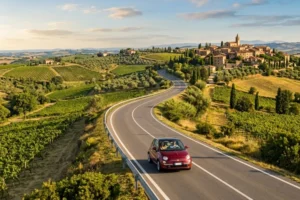
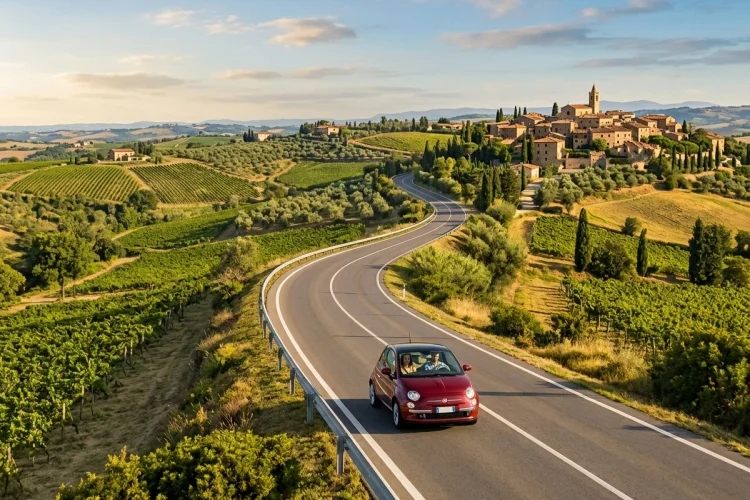
Val d’Orcia offers the classic Tuscan road-trip landscape: rolling farmland, rows of cypress trees, isolated farmhouses, thermal villages, vineyards, and medieval towns built above the valleys.
An official two-day driving itinerary covers around 50 kilometres through the area, proving that you do not need enormous daily distances to enjoy it properly. Montalcino, Pienza, San Quirico d’Orcia, and Bagno Vignoni are close enough to combine without rushing.
The driving is scenic rather than technically difficult, although roads become narrow near villages. Park outside the historic centres and walk in.
Limited Traffic Zones, known as ZTLs, operate in Siena and many other Tuscan centres, and entering without authorisation can lead to penalties.
Stay at a rural guesthouse or agriturismo so you can experience the countryside without repeatedly driving back to a large city. When visiting wineries, arrange tastings with a non-driving companion or return to your accommodation by booked transport.
6. The Douro Valley, Portugal
Suggested route: Porto-Peso da Régua-Pinhão
Ideal length: Two to three days
The Douro Valley is one of Europe’s most rewarding short driving routes. Roads follow hills covered with vineyard terraces, while viewpoints overlook the river, villages, and wine-producing estates.
Start in Porto, but collect your car only when you are ready to leave the city. Drive towards Peso da Régua, stay overnight nearby, and continue to Pinhão the following day.
Portugal’s official tourism board describes the UNESCO-listed valley as a landscape that can be explored by road, train, or boat. Driving provides access to smaller villages and rural accommodation that can be awkward to reach using public transport alone.
Some riverside and vineyard roads are winding, so keep daily distances short. Stop only at proper viewpoints rather than pulling over on narrow bends.
A combination works particularly well here: drive into the valley, leave the car at your accommodation, and take a boat or train for part of the sightseeing.
Essential Advice before Driving in Europe
Traffic laws are not identical across Europe. Speed limits, alcohol limits, required safety equipment, toll systems, and low-emission rules vary by country.
However, seat belts are compulsory, children require appropriate restraints, and handheld phone use while driving is prohibited across EU countries.
Confirm that your licence is accepted in every country on your itinerary. Travellers with non-European licences should ask the rental company and relevant national authority whether an International Driving Permit is also required.
Choose an automatic transmission when you are not confident driving a manual car. Book a smaller vehicle for village streets and parking garages, photograph existing damage during collection, and understand the insurance excess before signing.
Do not plan more than three or four hours of driving on most days. The purpose of a European road trip is to explore the places between your hotels, not simply to accumulate kilometres.
The best European road trips for first-time drivers combine attractive scenery with practical distances and plenty of opportunities to stop. The Algarve delivers accessible beaches, Alsace offers vineyard villages, and Germany’s Romantic Road connects historic towns.
Slovenia introduces the Alps without requiring a huge itinerary, while Val d’Orcia and the Douro Valley reward travellers who prefer slow countryside journeys.
Choose one compact region, rent a small car, and learn the local road rules before departure. Build extra time into every day so unexpected viewpoints, village lunches, and parking delays never become a crisis.
Select the route that matches your preferred scenery, check your licence and rental conditions, and begin planning your first European driving adventure.