Belgium travel itineraries often seem to follow the same pattern: spend a few days in Brussels, photograph the canals of Bruges, eat far too many waffles, and head home.
There is nothing wrong with that plan. Brussels and Bruges are popular for good reasons. But stop there and you will miss a surprisingly large part of what makes Belgium interesting.
The best places to visit in Belgium beyond Brussels and Bruges include lively university towns, medieval cities, riverside communities, major art centres, and tiny settlements surrounded by the forests and hills of the Ardennes.
Because Belgium is relatively compact, several of these destinations can also be combined into one trip rather than treated as separate holidays.
You might spend one morning exploring a castle in Ghent, another browsing Antwerp’s fashion districts, then find yourself beside the Meuse River beneath a dramatic fortress in Dinant.
Here are seven Belgian destinations worth adding to your itinerary.
1. Ghent: Medieval Belgium with a Younger Energy
If you like the architecture of Bruges but want somewhere that feels more like a functioning city than an open-air postcard, start with Ghent.
Its historic centre is packed with medieval landmarks. The Castle of the Counts, St Bavo’s Cathedral, Ghent Belfry, Graslei, and Korenlei are all among the major attractions, while St Bavo’s is home to the famous Ghent Altarpiece by the Van Eyck brothers.
The city also sits where the Lys and Scheldt rivers meet, making a canal or boat trip an especially good way to see it.
Yet Ghent does not feel stuck in the Middle Ages. University life, street art, cafés, restaurants, music, and nightlife give it a noticeably younger atmosphere.
It is particularly enjoyable after sunset, when illuminated bridges and historic façades turn the centre into one of Belgium’s most atmospheric evening walks.
2. Antwerp: Come for Art, Fashion and Big-City Energy
Antwerp offers something completely different.
This is a port city associated with diamonds, fashion and the legacy of Baroque painter Peter Paul Rubens.
Its historic core still delivers classic Belgian scenery around Grote Markt and the Cathedral of Our Lady, but modern galleries, fashion boutiques and regenerated waterfront areas give the city a more contemporary personality.
Art lovers have plenty to work with. The Plantin-Moretus Museum, KMSKA, MAS and other cultural institutions could easily occupy more than a day.
Antwerp is also an excellent destination if your ideal city break involves wandering between museums, interesting neigbourhood streets, cafés and independent shops rather than rushing between monuments.
Give it at least a full day; two nights are better if museums are a priority.
3. Leuven: History, Students and Belgian Beer Culture
Leuven proves that a relatively small city can have an enormous amount of personality.
Its identity is closely connected with KU Leuven, whose presence has shaped the city for more than six centuries. University buildings sit alongside busy cafés, historic churches and impressive landmarks such as the Gothic Town Hall and University Library.
One particularly peaceful stop is the Great Beguinage, a network of traditional houses, gardens, courtyards and small streets dating back to the 13th century. It forms part of the UNESCO-listed Flemish beguinages.
Then there is the beer. Leuven is closely associated with Stella Artois, but visitors can also explore smaller breweries and the wider local brewing tradition.
The combination makes Leuven ideal for travellers who want historic Belgium without losing the energy of a student city.
4. Dinant: Dramatic Scenery Along the Meuse
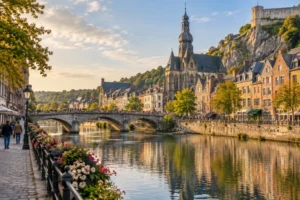
Few Belgian towns have a setting quite like Dinant.
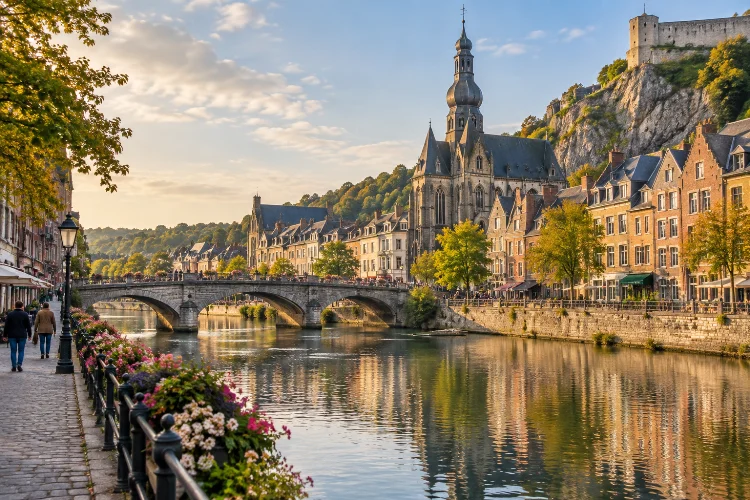
Colourful buildings line the Meuse River while steep limestone cliffs rise almost ectly behind them.
Above everything sits the Citadel of Dinant, which looks over the valley and reflects centuries of military history. VISITWallonia describes the fortress as offering around 900 years of history.
Music fans have another reason to visit: Dinant was the birthplace of Adolphe Sax, inventor of the saxophone. The connection is celebrated throughout the town, including at La Maison de Monsieur Sax.
Spend some time walking beside the river rather than simply checking off attractions. A boat trip on the Meuse can also reveal just how dramatic the surrounding landscape really is.
Dinant is compact, but visually it feels far bigger.
5. Namur: Slow Travel in Wallonia’s Capital
Namur rarely receives as much attention as Belgium’s bigger tourist cities, which is exactly part of its appeal.
The Walloon capital sits around the Sambre and Meuse rivers and is dominated by its enormous citadel. From the higher sections of the fortress, you can look across the historic centre and surrounding waterways. A cable car provides another way to appreciate the panorama.
Down below, the pace becomes gentler. Narrow streets lead between shops, terraces and restuarants, while landmarks include Saint-Aubain Cathedral, the Belfry and the Théâtre Royal.
Namur works particularly well for travellers who enjoy wandering without a strict checklist. Rather than racing between famous attractions, give yourself time for a long lunch, a riverside walk and a slow exploration of the old streets.
6. Mechelen: One of Belgium’s Most Underrated Historic Cities
Sitting between Brussels and Antwerp, Mechelen is easy to overlook. That would be a mistake.
Its compact centre contains historic churches, city palaces, the Large Beguinage and one particularly impossible-to-miss landmark: St Rumbold’s Tower.
The tower reaches roughly 97 metres high, and visitors can climb 538 steps to its skywalk for panoramic views across the region. On clear days, even landmarks around Brussels and Antwerp may be visible.
Mechelen’s smaller scale is an advantage. Major sights lie relatively close together, making the city easy to explore on foot without feeling like you are following a rigid sightseeing schedule.
It is a surprisngly strong choice for families too, with museums, waterside areas and child-focused walking experiences available around town.
7. Durbuy: Stone Streets and Ardennes Scenery
For a completely different side of Belgium, travel into the Ardennes and spend time in Durbuy.
Its historic centre is a maze of narrow cobbled lanes and old stone buildings wrapped around the River Ourthe. The surroundings quickly become greener and more rugged, giving Durbuy a completely different atmosphere from Belgium’s larger cities.
Nearby attractions include the Topiary Park and Roche à la Falize, a dramatic rock formation connected with the Famenne-Ardenne UNESCO Global Geopark.
Durbuy is particularly attractive for couples and anyone wanting to combine historic architecutre with hiking, forests and countryside.
Do not treat it purely as a quick photo stop, though. Staying overnight lets you experience the little streets once the daytime visitors begin to disappear.
How to Choose Where to Go
Your best destination depends on the kind of Belgian trip you want.
Choose Ghent for medieval history mixed with nightlife, Antwerp for fashion and major museums, or Leuven for university culture and beer. Mechelen suits travellers looking for an underrated historic city, while Namur delivers a slower Walloon experience.
For scenery, Dinant is difficult to beat. For a countryside escape and Ardennes atmosphere, Durbuy makes the stronger change of pace.
Better still, combine several. Belgium rewards travellers who move beyond its two most famous stops and discover how quickly the character of the country changes from one region to another.
Brussels and Bruges may be the names you already know, but they are only the beginning of what Belgium offers.
Ghent brings medieval architecture and youthful energy together. Antwerp adds fashion, art and urban culture, while Leuven combines university history with one of the country’s strongest beer traditions.
Travel south and the landscape changes again, with Namur’s fortress, Dinant’s spectacular Meuse Valley setting and Durbuy’s Ardennes charm. Mechelen quietly fills the gap with remarkable heritage and far fewer expectations.
So when planning your next Belgium itinerary, leave a little room between the famous stops. Pick two or three of these destinations, stay overnight where possible, and give yourself time to explore beyond the standard tourist route.