Eastern Europe is a brilliant choice when you want grand architecture, layered history, satisfying food, and memorable city breaks without following the most predictable European route.
You can begin the morning inside a medieval market square, spend the afternoon in a creative neighbourhood, and finish the day with dumplings, local beer, or coffee in a cosy café.
The challenge is deciding where to go first. The region covers a wide range of cultures and landscapes, so the ideal destination depends on whether you prefer castles, nightlife, museums, traditional cuisine, or easy day trips.
This guide to the Best Eastern European Destinations for First-Time Travellers focuses on six accessible cities: Kraków, Tallinn, Riga, Vilnius, Bucharest, and Sofia.
Each offers a walkable historic centre, distinctive local character, and enough variety for a two-to-four-day stay. Rather than rushing through all six, choose two or three that connect naturally and give yourself time to enjoy everyday life between the famous landmarks.
1. Kraków, Poland: Best for Medieval Charm and Polish Food
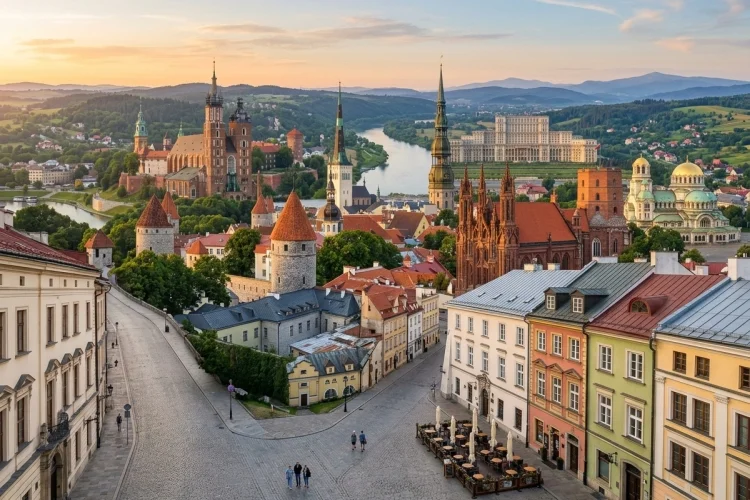
Kraków is an excellent introduction to Eastern European travel because many of its major attractions are close together. The enormous Main Market Square sits at the heart of the Old Town, surrounded by historic townhouses, churches, cafés, and the famous Cloth Hall.
A classic walking route begins near the medieval city walls, passes through Floriańska Street and the market square, and continues towards Wawel Castle. Kraków’s official Royal Route follows a similar path, making it easy for first-time visitors to understand the layout of the historic centre.
Explore Beyond the Main Square
Spend time in Kazimierz, the city’s historic Jewish district, where synagogues, museums, restaurants, and independent businesses sit side by side. The neighbourhood becomes especially lively in the evening.
Kraków is also a practical base for visiting the Wieliczka Salt Mine or Auschwitz-Birkenau. These popular sites often use timed entry, so reserve tickets before arrival instead of assuming you can purchase them at the entrance.
Three days is a comfortable minimum. That gives you two days in the city and one day for an excursion.
2. Tallinn, Estonia: Best for a Fairytale Old Town
Tallinn feels almost purpose-built for a first European city break. Its medieval centre is compact, atmospheric, and easy to explore on foot, although the cobbled lanes and steep sections around Toompea Hill require comfortable shoes.
Begin at Town Hall Square before wandering through narrow streets lined with merchant houses, hidden courtyards, towers, and old defensive walls. Tallinn’s historic centre tells more than 800 years of urban history and remains one of Europe’s most recognisable medieval city spaces.
For panoramic views, climb towards the Kohtuotsa or Patkuli viewing platforms. Afterwards, leave the Old Town and explore Kalamaja, a creative district known for wooden houses, cafés, cultural venues, and the Telliskivi area.
Spend at least two full days in Tallinn. A third day allows time for museums, a coastal walk, or a ferry excursion.
3. Riga, Latvia: Best for Architecture and Market Culture
Riga combines a medieval core with grand boulevards, riverside spaces, creative districts, and an impressive collection of Art Nouveau buildings. It feels larger and busier than Tallinn, but the main visitor areas remain manageable.
Start in the Old Town, where Dome Square, Town Hall Square, historic guild buildings, and winding lanes reveal the city’s long commercial history. The centre mixes restored heritage with restaurants, museums, and an active cultural scene.
One of Riga’s biggest highlights is the Central Market. Housed partly inside enormous former aviation hangars, it is a good place to see local produce, smoked fish, baked goods, dairy products, and everyday Latvian food culture.
Stay for two or three nights. On a longer visit, take a train to Jūrmala for Baltic beaches, wooden villas, and a refreshing change from city sightseeing.
4. Vilnius, Lithuania: Best for Baroque Streets and Creative Energy
Vilnius is a relaxed capital with church towers, colourful courtyards, green spaces, and one of the most attractive historic centres in the Baltic region. It is less visually uniform than Tallinn, which makes wandering through its streets feel more spontaneous.
Explore Cathedral Square, Vilnius University, Pilies Street, the Gates of Dawn, and the maze of lanes connecting the city’s churches and small squares. The Old Town reflects several architectural periods, although its elegant Baroque character is particularly memorable.
Cross into the Republic of Užupis
Užupis is a small artistic neighbourhood that humorously declared itself an independent republic. Its constitution, street art, workshops, cafés, and riverside atmosphere make it an enjoyable contrast to the formal historic centre.
With three days, you can also visit Trakai, a former capital known for its island castle. Tours and public transport make it a manageable half-day or full-day excursion from Vilnius.
5. Bucharest, Romania: Best for Contrasts and Nightlife
Bucharest is not a polished storybook capital, and that is exactly what makes it interesting. Belle Époque buildings, communist-era monuments, Orthodox churches, contemporary cafés, large parks, and energetic nightlife all compete for attention.
Walk along Calea Victoriei to see landmarks such as the Romanian Athenaeum and Revolution Square. Continue towards the Old Town, where pedestrian streets are filled with restaurants, bars, historic churches, and late-night activity.
The Palace of Parliament is the city’s most imposing landmark, but access usually requires a guided visit and advance planning. First-time travellers can navigate central districts on foot, while the metro is useful for covering longer distances.
Allow three days for Bucharest. That provides enough time for major sights, parks, museums, and a neighbourhood beyond the Old Town.
6. Sofia, Bulgaria: Best for History and Mountain Access
Sofia is one of the region’s most underrated capitals. Roman remains, Ottoman-era buildings, Orthodox churches, communist architecture, and modern commercial streets appear within a relatively compact central area.
Alexander Nevsky Cathedral is the headline attraction, but the nearby Saint Sofia Church, National Gallery, ancient Serdica ruins, and central mineral baths help explain the city’s layered past.
An official Sofia audio route covers 25 historic sites, giving first-time visitors an accessible way to explore the centre.
Sofia also offers something many capitals cannot: quick access to mountain scenery. Vitosha Mountain rises just outside the city and provides walking routes, viewpoints, and cooler air during summer.
Plan two or three nights. Add another day when hiking or visiting Rila Monastery is part of your itinerary.
How to Plan Your First Eastern Europe Trip
Avoid combining destinations simply because they appear close on a map. Border crossings, indirect rail connections, and long bus journeys may consume more time than expected.
The three Baltic capitals create the most natural regional itinerary. Tallinn, Riga, and Vilnius can be covered in seven to ten days, although some rail services remain limited or operate only on particular schedules. Coaches are often useful, so compare current options before booking.
Kraków works well with Warsaw, Wrocław, or nearby Central European cities. Bucharest and Sofia can also form part of a longer Balkan route, but spending at least three nights in each capital will make the journey feel much less rushed.
Spring and early autumn generally suit city sightseeing because the weather is comfortable and major attractions are less crowded than during peak summer. Winter brings Christmas markets and lower temperatures, while summer offers longer days but may require earlier accommodation bookings.
Carry a bank card but keep a small amount of local currency for markets, small businesses, or transport machines. Poland, Romania, Bulgaria, and several other countries in the region do not use the euro, so check the official currency before arrival.
The Best Eastern European Destinations for First-Time Travellers combine accessible city centres with architecture, food, culture, and history that feel genuinely different from one border to the next.
Kraków offers medieval streets and Polish traditions, while Tallinn, Riga, and Vilnius create an excellent introduction to the Baltic states. Bucharest delivers urban contrasts and nightlife, and Sofia adds ancient landmarks with easy access to the mountains.
The smartest first trip focuses on a small, connected area rather than an exhausting list of capitals. Choose two or three destinations, allow several nights in each, and reserve popular attractions before departure.
Start comparing routes now, pick the cities that best match your interests, and build an Eastern European adventure that gives you time to explore rather than simply arrive.