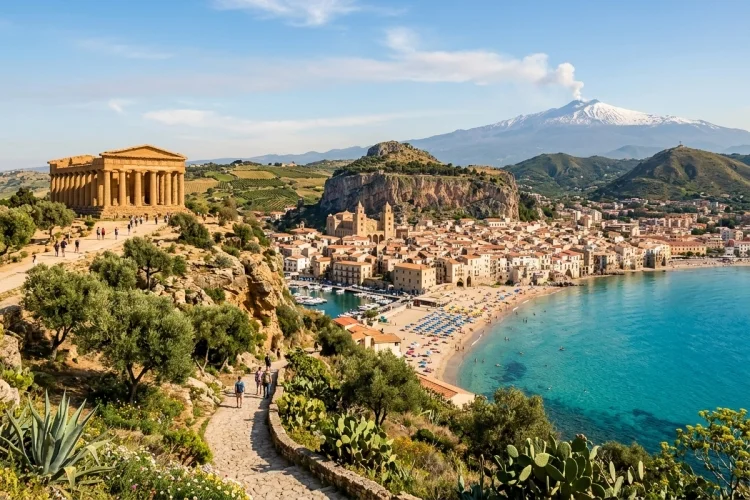
Sicily is not the kind of destination you can neatly tick off in a weekend. Italy’s largest island feels more like a small country, with energetic cities, mountain villages, Greek temples, Baroque towns, volcanic landscapes, and beaches ranging from wide sandy bays to rocky swimming coves.
That variety makes planning exciting, but it can also overwhelm first-time travellers. Should you begin with Palermo or Catania? Is Taormina worth the crowds? How many ancient ruins can you realistically visit before needing an afternoon beside the sea?
This guide to Sicily for First-Time Visitors focuses on a balanced first trip. It combines Palermo’s food markets, Cefalù’s beach, Agrigento’s Greek temples, Syracuse’s ancient history, Taormina’s coastal views, and Mount Etna’s volcanic scenery.
The aim is not to cover the entire island. It is to experience Sicily’s cities, beaches, food, and archaeological heritage at a pace that still feels like a holiday.
1. Start with a Realistic Sicily Itinerary
Sicily is larger than it looks on a map, and journeys between major destinations can take several hours. For a seven-day holiday, choose either western Sicily or the eastern and southeastern coast rather than constantly crossing the island.
A ten-day trip gives you enough time for a broader route. You could begin in Palermo, continue to Cefalù and Agrigento, then travel east towards Syracuse, Taormina, and Catania.
Flying into one airport and departing from another can reduce backtracking. Palermo Airport works naturally for the west, while Catania Airport is convenient for Taormina, Mount Etna, Syracuse, and the Baroque towns of southeastern Sicily.
Try to stay at least two nights in your main bases. Changing accommodation every day may allow you to see more places on paper, but it also means repeatedly packing, parking, and checking in.
2. Experience Palermo’s Architecture and Street Food
Palermo is loud, fascinating, slightly chaotic, and full of personality. Its historic centre combines grand churches, faded palaces, lively markets, street-food counters, and architecture influenced by centuries of Mediterranean cultures.
The UNESCO-listed Arab-Norman heritage route includes monuments in Palermo as well as the cathedrals of nearby Monreale and Cefalù. These buildings reflect the mixture of Western, Islamic, and Byzantine traditions that developed during the Norman Kingdom of Sicily.
Walk between Palermo Cathedral, the Norman Palace, the Palatine Chapel, Quattro Canti, and Piazza Pretoria. The distances are manageable, but leave time to notice small courtyards, churches, workshops, and neighbourhood streets along the way.
Eat Your Way through the Markets
Ballarò, Capo, and Vucciria introduce visitors to Palermo’s market culture. Depending on where you stop, you may find arancine, panelle made from chickpea flour, potato croquettes, grilled meat, seafood, pastries, fruit, and local cheeses.
Street food is part of the experience, but choose busy stalls where ingredients are being prepared regularly. Begin with a few smaller dishes instead of ordering everything that looks interesting at the first counter.
Spend two or three nights in Palermo. That gives you time for the centre, Monreale, and a half-day at Mondello, the city’s popular seaside area.
3. Combine Cefalù’s Old Town with a Beach Day
Cefalù is one of the easiest places to combine Sicilian culture with a relaxed day beside the sea. Its sandy beach sits directly below a historic town of honey-coloured buildings, small lanes, restaurants, and traditional houses.
The Norman cathedral forms part of Sicily’s UNESCO-listed Arab-Norman heritage, while the Rocca rises above the town and rewards energetic visitors with wide coastal views. Cefalù’s appeal comes from having architecture, food, swimming, and scenery within a compact area.
Cefalù can be visited as a day trip from Palermo, but staying overnight creates a better experience. The centre becomes calmer after many day visitors leave, and you can enjoy the beach early the following morning.
For a quieter coastal adventure, look towards the Zingaro Nature Reserve and San Vito Lo Capo in northwestern Sicily. These require more travel time, so they work better as part of a western Sicily road trip than as a rushed excursion from Palermo.
4. Walk among Ancient Temples in Agrigento
The Valley of the Temples is one of Sicily’s essential archaeological experiences. Located near Agrigento, the park preserves the monumental remains of Akragas, once one of the Mediterranean’s important Greek colonies.
Despite its name, the archaeological area stretches along an elevated ridge rather than sitting inside a narrow valley. Its most famous structures include the Temple of Concordia, the Temple of Juno, and the remains associated with Heracles and Olympian Zeus.
Allow at least three hours and avoid arriving without water during summer. The site is large, exposed, and much more enjoyable in the morning or late afternoon than under the strongest midday sun.
Stay overnight in Agrigento when your route allows it. Seeing the temples in the warmer evening light gives the landscape a completely different atmosphere, and it prevents you from combining a long visit with several hours of driving.
5. Explore Ancient Syracuse and Baroque Noto
Syracuse provides one of Sicily’s best combinations of archaeology and attractive city life. Its historic heart is Ortigia, a compact island connected to the mainland by bridges and filled with waterfront streets, markets, Baroque buildings, and atmospheric squares.
The Cathedral of Syracuse is particularly remarkable because it incorporates columns from an ancient temple dedicated to Athena. Nearby, the Temple of Apollo and the Arethusa spring reveal how deeply Greek history remains woven into the modern city.
Across the mainland, the Neapolis Archaeological Park contains the Greek Theatre, Roman Amphitheatre, and the limestone cave known as the Ear of Dionysius. Syracuse and the nearby rocky necropolis of Pantalica are recognised together as a UNESCO World Heritage Site.
Use your second day for Noto, around 40 minutes away by road under normal conditions. Its elegant churches, balconies, staircases, and golden façades represent the spectacular Baroque rebuilding of southeastern Sicily.
6. Balance Taormina’s Views with Mount Etna
Taormina is polished, popular, and undeniably beautiful. The hillside town overlooks the Ionian Sea, with Mount Etna forming a dramatic background on clear days.
Its Ancient Theatre is the main attraction, combining an archaeological site with views across the coast and volcano. Below the town, Isola Bella is connected to the shore by a narrow pebbled strip that may be partly covered when the water rises.
Visit early in the morning or stay overnight to enjoy Taormina outside the busiest daytime period. For a slightly quieter atmosphere, explore Castelmola in the hills above town or base yourself near Giardini Naxos.
Mount Etna deserves a separate day. Recognised by UNESCO for its geological importance and volcanic activity, it features craters, lava fields, caves, and the vast Valle del Bove depression.
Conditions on the volcano can change, so check official access guidance and weather forecasts before leaving. Wear proper shoes and bring warm layers, even when the coastline below feels hot.
7. Make Time for Sicily’s Beaches
Sicilian beaches are surprisingly diverse. Mondello offers an easy sandy escape from Palermo, Cefalù combines swimming with a historic town, and Isola Bella provides clear water beneath Taormina’s cliffs.
Southeastern Sicily is especially useful when you want beaches close to cultural attractions. The Vendicari Reserve, between Noto and Marzamemi, has coastal walking paths, wetlands, sandy stretches, and natural coves such as Calamosche.
Facilities are limited, so visitors should bring water, food, sun protection, and suitable footwear.
Do not try to visit a famous beach every day. Choosing one or two coastal areas near your accommodation reduces driving and gives you enough time to enjoy the sea properly.
June and September often provide warm swimming conditions with a calmer atmosphere than peak summer. During July and August, begin early because popular beaches and parking areas can fill quickly.
8. Decide Whether You Need a Rental Car
You can explore parts of Sicily by train, particularly the routes connecting Palermo, Cefalù, Messina, Taormina, Catania, and Syracuse. Trenitalia operates regional services and offers digital regional tickets through its website and app.
A rental car is more useful for rural accommodation, remote beaches, mountain towns, archaeological sites, and flexible trips through the southeast. However, driving inside Palermo and Catania can be stressful, while historic centres may have restricted traffic zones.
A practical compromise is using trains between major cities and renting a car for only part of the trip. Always check parking arrangements before booking accommodation, particularly in compact places such as Taormina and Ortigia.
Sicily for First-Time Visitors should feel like an introduction, not an attempt to complete the island. Palermo delivers architecture and energetic markets, Cefalù combines a Norman town with an accessible beach, and Agrigento reveals Sicily’s extraordinary Greek past.
Syracuse and Noto bring ancient and Baroque history together, while Taormina and Mount Etna provide some of the island’s most dramatic scenery. Plan around two or three main bases, limit long driving days, and leave time for local meals and spontaneous swimming stops.
Choose whether western or eastern Sicily best matches your interests, then build a route that allows you to stay rather than constantly move. Start with your travel dates, book your first base, and let the island unfold one region at a time.